For industrial stainless steel buyers, the choice between 304 and 316 is rarely a theoretical material comparison. In real procurement scenarios, it directly affects project lifespan, maintenance cost, and long-term corrosion performance.
As global stainless steel prices continue to fluctuate, especially with changes in nickel and alloy costs, more buyers are re-evaluating whether upgrading from AISI 304 stainless steel to 316 is truly necessary—or simply an over-specification driven by risk perception.
The correct answer depends on one key factor: environmental exposure and lifecycle cost, not material grade alone.
AISI 304 stainless steel remains the global standard for general-purpose stainless steel applications. Its popularity is not accidental—it is the result of an optimal balance between cost, corrosion resistance, and manufacturability.
In most non-aggressive environments, 304 performs reliably for decades without major degradation.
Typical applications include:
This is why 304 continues to dominate bulk procurement across global stainless steel markets. However, its limitations become visible in chloride-rich or chemically aggressive environments.
The difference between 304 and 316 stainless steel is not about strength—it is about corrosion resistance chemistry. The addition of molybdenum in 316 significantly enhances resistance to chlorides and pitting corrosion, which is the primary failure mode in harsh environments.
| Property | AISI 304 Stainless Steel | AISI 316 Stainless Steel |
| Main Alloy Composition | Cr + Ni (18/8) | Cr + Ni + Mo |
| Corrosion Resistance | Good (general environments) | Excellent (chloride-rich environments) |
| Pitting Resistance | Moderate | High |
| Marine Suitability | Limited | Suitable |
| Chemical Resistance | Standard industrial | Enhanced |
| Cost Level | Lower | Higher |
| Common Use | Square bar, sheet, pipe | Marine, chemical equipment |
The decision to upgrade is not driven by preference—it is driven by environmental stress.
The following conditions typically justify switching from 304 to 316:
In these cases, corrosion risk is not theoretical—it is measurable and progressive. Once chloride exposure becomes consistent, 304 stainless steel begins to lose its protective stability over time, especially in pitting-prone conditions.
To make procurement decisions easier, industrial buyers often rely on simplified environmental thresholds.
| Environment Type | Recommended Grade | Reason |
| Indoor dry factory | 304 | Cost-efficient, fully sufficient |
| General outdoor urban | 304 | Stable atmospheric performance |
| Coastal environment | 316 | Salt resistance required |
| Marine/offshore | 316 | High chloride exposure |
| Chemical plant | 316 | Corrosion resistance priority |
| Food processing | 304 or 316 | Depends on cleaning chemicals |
Despite clear guidelines, many industrial buyers still default to 316 stainless steel—even when 304 would perform adequately.
The main reasons include:
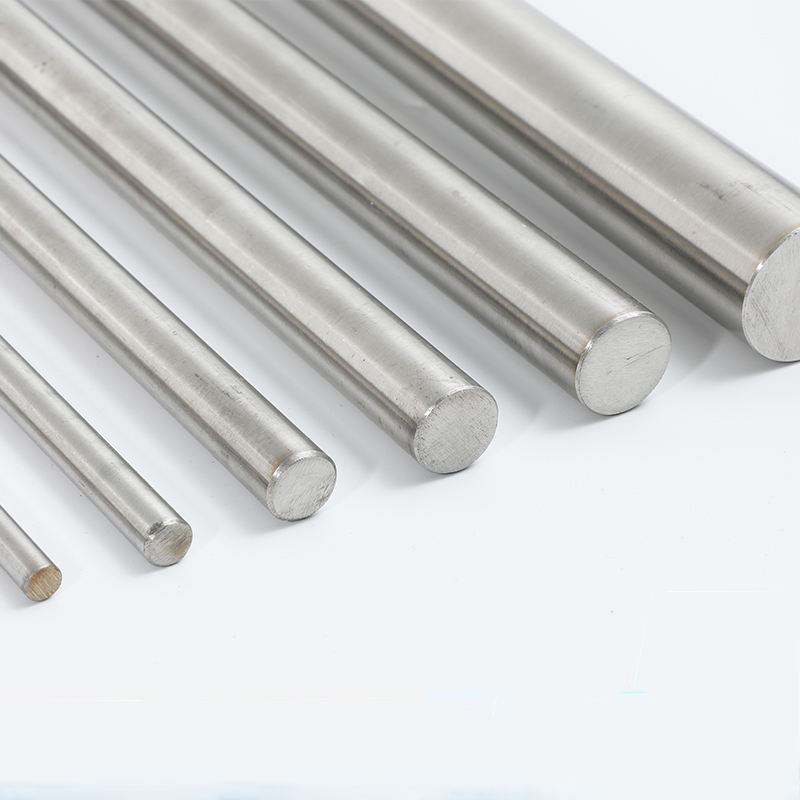
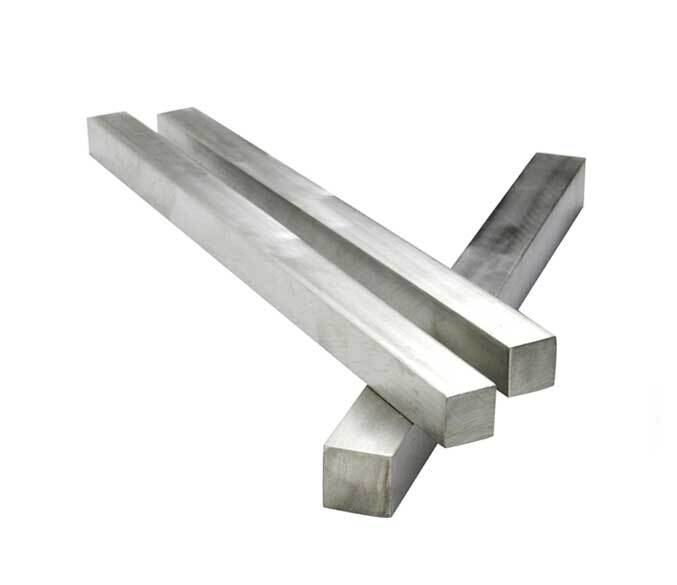
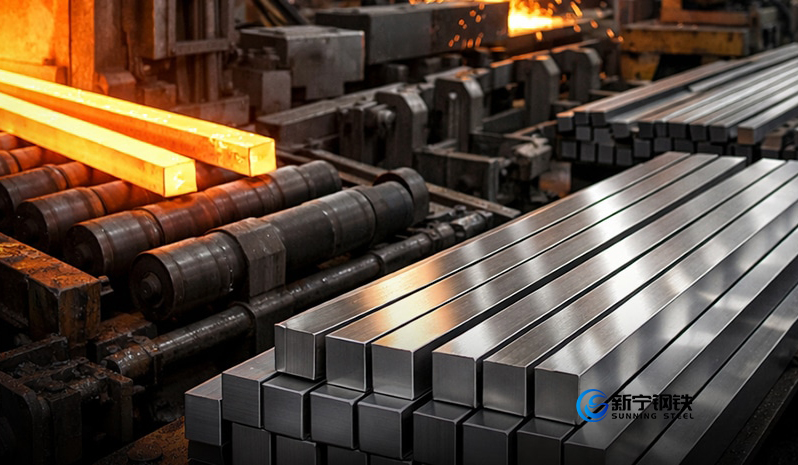
However, this approach often leads to unnecessary cost increases without proportional performance gain. For example, in non-corrosive environments, upgrading stainless steel square bar from 304 to 316 may significantly increase material costs without extending service life in any meaningful way.
Stainless steel pricing is increasingly influenced by global raw material volatility, especially nickel and molybdenum markets. Because 316 contains additional alloying elements, its price is more sensitive to fluctuations in raw materials.
As a result, the price gap between 304 and 316 can widen significantly during market volatility cycles.
For large-scale industrial buyers, this creates a real procurement dilemma: Should the budget be allocated to higher-grade material, or optimized through correct material selection?
One of the most important considerations in modern stainless steel procurement is lifecycle cost—not just purchase price. While 316 stainless steel is more expensive upfront, it may reduce long-term maintenance costs in aggressive environments. However, in mild environments, 304 often provides the same lifecycle performance at a significantly lower cost base.
This is why professional buyers evaluate maintenance frequency, Replacement cycles, corrosion risk probability, and downtime cost, rather than focusing only on the unit price.
304 and 316 stainless steel are not competing materials—they are environment-specific solutions. 304 is optimized for general industrial use, and 316 is engineered for corrosive and chloride-rich conditions.
A rational procurement decision is not based on upgrading to the “best” material, but on selecting the most efficient material for the actual working environment. This approach allows for reliable performance while controlling procurement costs. It also optimizes lifecycle value and reduces unnecessary over-specification.
The decision to upgrade from 304 to 316 stainless steel should always be driven by environmental demand rather than assumption or safety bias.
AISI 304 stainless steel continues to dominate global industrial applications due to its excellent balance of performance and cost efficiency, particularly in structural products such as stainless steel square bar, sheet, and general fabrication components. 316 stainless steel remains essential in corrosive environments where chloride exposure and chemical resistance determine equipment lifespan.
For industrial buyers, the most effective strategy is not to choose the highest-grade material—but to select the correct grade based on real-world operating conditions and lifecycle economics.
That is where true procurement efficiency is achieved.